

AI that eases the burden of day-to-day care: GAT, Pflegana and ScaDS.AI are pooling their expertise to develop new AI-based support solutions
How can artificial intelligence provide meaningful support to family carers in their day-to-day lives without replacing professional advice or nursing decisions?
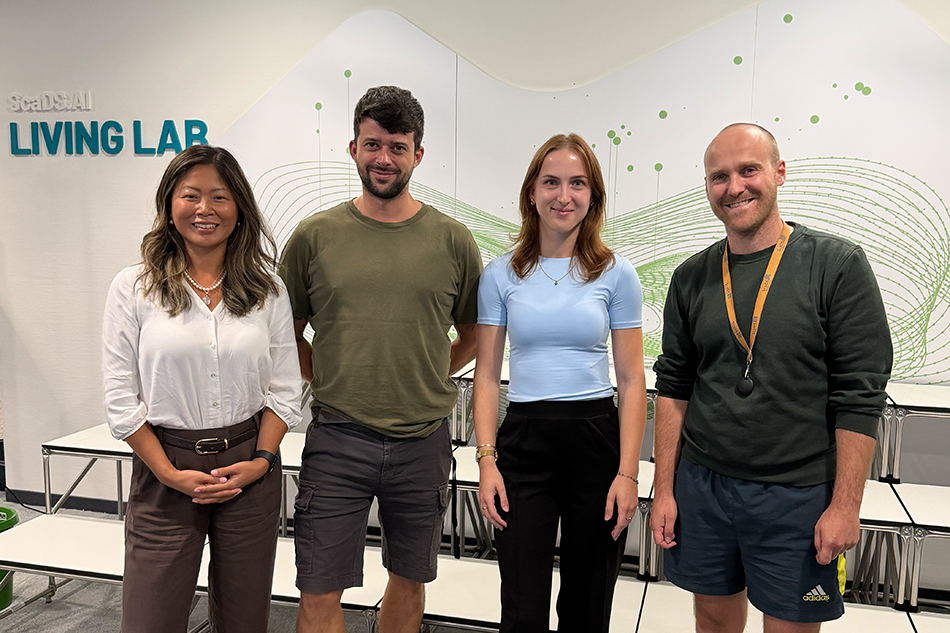
The GAT Institute – Institute for Health, Ageing, Work and Technology at Zittau/Görlitz University of Applied Sciences – the start-up Pflegana and ScaDS.AI Dresden/Leipzig intend to investigate this question jointly. To this end, the partners are combining practical social work expertise, experience in the care sector, user-centred technology development and scientific AI expertise.
The collaboration centres on the development and testing of a socially oriented relief, guidance and support measure for family carers providing care at home. The aim is not to create a comprehensive technical system or provide medical assistance. Rather, the aim is to investigate how AI can relieve the burden on family carers when navigating support systems, searching for suitable support services and carrying out recurring organisational tasks.
Common starting point: living lab approaches, AI education open to all target groups, and networking
A common starting point for this collaboration lies in open knowledge-sharing and engagement formats that give people access to artificial intelligence, regardless of their age, prior knowledge or institutional affiliation. Both the Living Lab run by ScaDS.AI and the activities of the GAT Institute aim to communicate technology – and artificial intelligence in particular – in a way that is understandable, practical and socially relevant. This explicitly includes informing older people about the opportunities, limitations and specific applications of AI, and empowering them to engage with digital technologies in a self-determined and reflective manner.
The GAT Institute and ScaDS.AI came together as part of several jointly organised events focusing on issues relevant to older people. It became clear at these events how important it is to have formats tailored to the target group – formats that do not explain technological developments in abstract terms, but rather align them with specific life situations and societal needs. From this exchange, a shared perspective emerged: to link issues of ageing, care and digital participation more closely with application-oriented AI literacy.
The connection between Pflegana and ScaDS.AI was established via the ScaDS.AI Meetup. The Meetup has developed into an established networking platform that brings together stakeholders from research, business, civil society and the public sector. It is of interest not only to local and regional partners, but also to those from across the country who wish to discuss new application ideas, combine specialist perspectives and initiate collaborations.
These events gave rise to a shared perspective: that AI should not be viewed in isolation as a purely technological matter, but rather developed in a way that is understandable, participatory and accountable within socially relevant contexts. This forms the basis for the collaboration between the GAT Institute, Pflegana and ScaDS.AI in the field of support for family carers.
Why new approaches to support are needed in day-to-day care
Family carers take on a significant proportion of home care. In addition to the actual care work, they often have to research information, clarify responsibilities, prepare applications, find advice services and coordinate numerous organisational tasks.
Many existing services are valuable from a professional point of view, but are scattered across various organisations, websites and formats. Particularly in stressful everyday situations, it can be difficult to find relevant information, make sense of it and apply it to one’s own circumstances.
AI systems can open up an additional avenue of access here: they can process information from various, verified sources in a way tailored to the specific situation, communicate in natural and, as far as possible, understandable language, and be available at any time. The added value therefore lies not merely in the digitisation of information, but in its context-sensitive, adaptive and practical delivery.
What we want to develop and trial together
The partners aim to investigate how an AI-supported support measure should be designed so that it is genuinely usable, accepted and accountable for family carers, and can be integrated into existing support systems.
Possible areas of application include, in particular:
- guidance on suitable regional support services,
- the clear presentation of service and respite options,
- the structuring and preparation of counselling sessions,
- practical assistance with recurring organisational and documentation tasks.
The specific design should not be determined solely from a technical perspective. A participatory approach is planned, in which family carers and relevant practitioners systematically contribute their experiences, needs and requirements to the development process. On this basis, selected application scenarios are to be implemented as prototypes, tested in realistic situations and scientifically evaluated in terms of their benefits, comprehensibility and practical suitability.
Pflegana is already working on AI-supported solutions for family carers and care services, designed to simplify administrative tasks such as gathering information, preparing applications and coordination. The company explicitly distinguishes its services from medical advice, focusing instead on organisational support and guidance.
Different skills, a common goal
Die Stärke der Zusammenarbeit liegt in den komplementären Perspektiven der drei Partner.
Das GAT-Institut bringt seine sozial- und pflegewissenschaftliche Forschungskompetenz sowie seinen Co-Creation-Ansatz ein, bei dem Betroffene von Beginn an in Forschungs- und Entwicklungsprozesse eingebunden werden. Dazu gehören Erfahrungen in der partizipativen Bedarfserhebung und wissenschaftlichen Begleitung sowie ein enges Netzwerk zu Pflege-, Beratungs- und Unterstützungsstrukturen in der Region. So wird sichergestellt, dass die entwickelten Lösungen an den tatsächlichen Bedarfen pflegender Angehöriger ausgerichtet und an bestehende Versorgungsstrukturen anschlussfähig sind.
Pflegana übernimmt die nutzerzentrierte und technische Perspektive. Dazu gehören Erfahrungen in der Entwicklung KI-gestützter Anwendungen, in der Gestaltung verständlicher Interaktionen und in der Übersetzung konkreter Anforderungen aus dem Pflegealltag in prototypische Lösungen.
ScaDS.AI ergänzt die Zusammenarbeit um wissenschaftliche KI-Kompetenz, methodische Begleitung und Erfahrungen im Transfer zwischen Forschung und gesellschaftlicher Praxis. Das Living Lab von ScaDS.AI schafft hierfür einen nutzerzentrierten Experimentier- und Begegnungsraum, in dem aktuelle Entwicklungen aus KI, Big Data und Data Science erfahrbar gemacht und mit verschiedenen gesellschaftlichen Gruppen diskutiert werden.
Gemeinsam wollen die Partner nicht nur einen Prototyp entwickeln, denn ebenso wichtig sind übertragbare Erkenntnisse: Welche Unterstützung benötigen pflegende Angehörige tatsächlich? Wo bietet KI gegenüber statischen Informationsangeboten einen erkennbaren Mehrwert? Welche Anforderungen bestehen an Verständlichkeit, Vertrauen, Datenschutz und Verantwortbarkeit? Und wie können KI-gestützte Angebote bestehende Beratungs- und Unterstützungsstrukturen sinnvoll ergänzen?
Die Zusammenarbeit soll dazu beitragen, diese Fragen praxisnah, partizipativ und wissenschaftlich fundiert zu bearbeiten.
The Institute for Health, Ageing, Work and Technology (GAT) is a research institute at Zittau/Görlitz University of Applied Sciences which, since 2016, has been conducting interdisciplinary research into issues relating to health, care, ageing and technology. The Institute’s mission is to shape societal challenges such as demographic change and digitalisation in a way that benefits older people, professional carers and family carers, amongst other things by researching trust, comprehensibility and acceptance of technical assistance systems. Central to this is the co-creation approach, in which the use of technical innovations is explored on the basis of the needs of the respective target groups. The focus is always on people, rather than the technology itself. The GAT Institute also brings this perspective to its collaboration with Pflegana and ScaDS.AI.
Pflegana is a care-tech start-up founded in 2025 that is developing an AI-powered companion for family carers. It is designed to relieve family carers of organisational and administrative tasks, such as applying for a care level, communicating with authorities and care services, and carrying out routine tasks in day-to-day care. Pflegana was founded by Bettina Kleemann (CEO) and Alessio Zachariades (CPO); the idea arose from their own experience as family carers over several years and their desire for a solution that not only provides information but also offers tangible relief.
ScaDS.AI Dresden/Leipzig is a national centre of excellence for data science, artificial intelligence and big data, with sites at Dresden University of Technology and the University of Leipzig. The centre combines interdisciplinary basic and applied research with knowledge transfer, skills development and engagement with industry and society. The Living Labs in Dresden and Leipzig create open spaces for experimentation and interaction, where the latest AI research can be experienced through concrete applications and new collaborations can emerge.
2.Obergeschoss